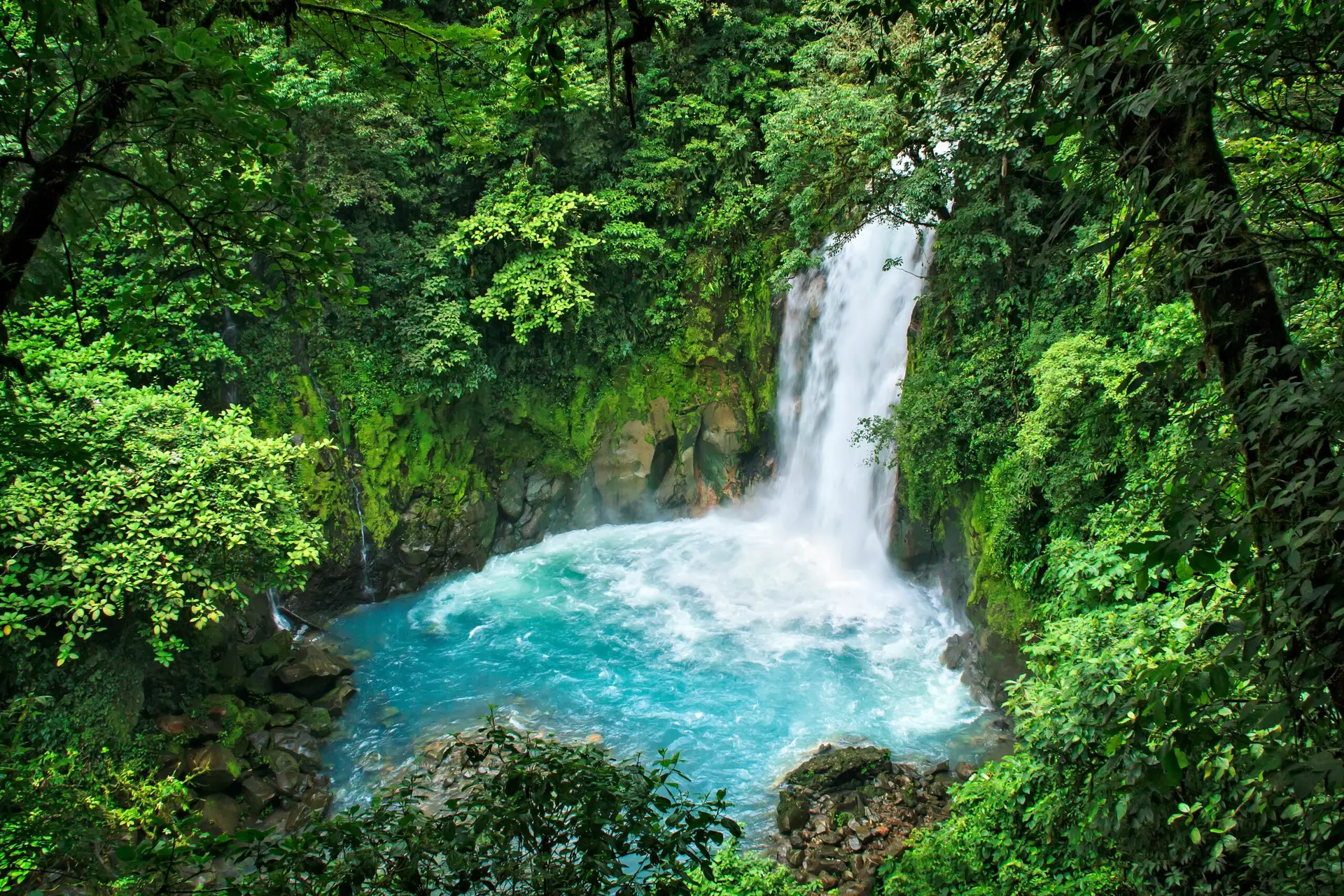
Two seasons, and many shades in between
When Costa Ricans talk about the weather, they mention two seasons: verano, the dry season, and invierno, the green season. But across 51,100 km² (19,700 sq mi), an area slightly smaller than West Virginia, the mountains and the two oceans create a wide range of regional climates.
Between the Pacific to the west and the Caribbean Sea to the east, the mountain ranges, which peak at 3,821 meters (12,536 ft) on Chirripó, separate regions whose rhythms are sometimes opposite, only a few hours’ drive apart. Understanding this geography is the first step to planning your trip well.
Think in regions rather than seasons
To choose your dates, think region by region rather than by the calendar: while the sun shines on the beaches of Guanacaste, it may be raining in Cahuita, and the other way around.
The dry season: December to April
On the Pacific slope and in the Central Valley, the dry season runs from December to April: clear skies, heat and dry air. It is the most popular time for beaches, hiking and national parks; it is also the high season, with more visitors at the best-known sites.
The Caribbean coast follows a different rhythm: in December, showers fall mostly in the afternoon and mornings are often fine; in January, they are frequent at night; February and March are fairly dry.
The green season: May to November
Also called the rainy season, the green season deserves better than its reputation. Early in the season, showers fall mostly in the afternoon and mornings are often fine; the forest turns green again, rivers swell and wildlife is very active. In late June and July, the Pacific slope often enjoys the veranillo, a few drier weeks.
September and October are the wettest months on the Pacific, especially in the center and south: it can then rain for several hours, sometimes several days. This is precisely the best time for the Caribbean coast, often sunny during this period.
No bad season, just different moods
From December to April, conditions are ideal for beaches, long hikes and outdoor excursions; roads are easier, but the best-known sites are also busier.
From May to August, nature is generous: frogs, toucans, monkeys and macaws are often easy to spot, and nature photographers love the changing light. May and November, the transition months, bring lush vegetation, few crowds and often lower rates.
Tropical rain, an ally
Rain drives everything that makes Costa Rica what it is: it feeds the forests, fills the rivers for rafting and kayaking, and keeps up the palette of greens that so many travelers remember. A late-afternoon shower cools the air and releases the scents of the forest; a good rain jacket and a flexible schedule are all you need to enjoy it.
The weather region by region
| Region | Dry season (December to April) | Green season (May to November) | Good to know |
|---|
| North Pacific (Guanacaste, Nicoya) | Very dry, hot and sunny; frequent wind from December to March | Afternoon showers, heavier in September and October | The driest region in the country; golden dry forest at the end of the season |
|---|
| Central Pacific (Manuel Antonio, Carara) | Sunny and hot | Afternoon showers, heavy in September and October | A good balance between forest and ocean |
|---|
| South Pacific and Osa Peninsula (Drake, Corcovado) | Dry until March or April | Very wet from September to November | Some lodges close in October |
|---|
| Central Valley (San José, Heredia, Turrialba) | Mild and sunny, cool nights, wind from December to February | Afternoon showers | Temperate climate, pleasant all year round |
|---|
| Northern lowlands (Arenal, Sarapiquí, Río Celeste) | Drier from February to April, showers always possible | Frequent rain | Humid and green all year round |
|---|
| Mountains (Monteverde, San Gerardo de Dota) | Cool, misty and windy | Afternoon showers, fog | Cool nights, even cold above 2,000 m (6,500 ft) |
|---|
| Caribbean coast (Tortuguero, Cahuita, Puerto Viejo) | Rain possible; February and March fairly dry | September and October often sunny; July rainy | Constant humidity; a rhythm offset from the Pacific |
|---|
Month by month: when to go?
These guidelines describe usual trends; the weather varies from one year to the next and from one valley to another.
| Month | Pacific slope and Central Valley | Caribbean coast | Good to know |
|---|
| January | Dry and sunny, windy in Guanacaste | Frequent showers at night | High season: book early; humpback whales from the north |
|---|
| February | Dry and sunny | Fairly dry | A good time to combine both coasts; humpback whales from the north |
|---|
| March | Dry, getting hotter | Fairly dry | Holy Week in March or April: many local travelers |
|---|
| April | End of the dry season, hottest in Guanacaste | Quite dry | Golden landscapes in Guanacaste |
|---|
| May | First afternoon showers | Variable | The forest turns green again; lower rates |
|---|
| June | Afternoon showers, mornings often fine | Rainy at times | Very active wildlife; few crowds |
|---|
| July | “Veranillo”: a few drier weeks | Often rainy | Green turtle nesting in Tortuguero; humpback whales arrive from the south |
|---|
| August | Afternoon showers | Gradually improving | Turtles in Tortuguero; peak humpback whale watching |
|---|
| September | Among the wettest months, especially in the center and south | One of the driest months | Ideal for the Caribbean coast; peak humpback whale watching |
|---|
| October | The wettest month in many places | Often sunny | Favor the Caribbean and the north; some Osa lodges close |
|---|
| November | Transition: rain eases at the end of the month | Rain returns | Lush nature, still few crowds |
|---|
| December | Start of the dry season | Afternoon showers, mornings often fine | Christmas and New Year: crowds and high rates; first humpback whales from the north |
|---|
Humpback whale watching
On the Pacific coast, especially in the South Pacific, humpback whales can be seen twice a year.
| Period | Season | Highlights |
|---|
| July to October | Southern Hemisphere migration | A particularly good period, usually peaking in August and September; mothers with calves can often be seen. |
|---|
| December to March | Northern Hemisphere migration | A second viewing period, especially in January and February. |
|---|
| April to June | Transition period | Humpback whale sightings are generally less frequent. |
|---|
Exact periods vary from year to year and with sea conditions. Whale watching remains a natural experience whose outcome can never be guaranteed.
Temperatures
- Pacific coast: 28 to 35 °C (82 to 95 °F) during the day depending on the region and season, around 22 to 24 °C (72 to 75 °F) at night; dry heat from December to April, more humid afterwards.
- Caribbean coast and northern lowlands: around 29 to 31 °C (84 to 88 °F) by day and 21 to 23 °C (70 to 73 °F) at night, with high humidity all year round.
- Central Valley: between 900 and 1,500 meters (3,000 to 5,000 ft), a temperate climate of about 17 to 27 °C (63 to 81 °F), with cool nights.
- Mountains: in Monteverde, around 1,500 meters (5,000 ft), nights are cool, around 15 °C (59 °F); in San Gerardo de Dota and above 2,000 meters (6,500 ft), they can drop to about 5 °C (41 °F).
What to pack
Light, breathable clothing: linen, light cotton or quick-drying technical fabrics; two or three outfits are enough, laundry is easy everywhere.
A light rain jacket with a hood, essential in every season.
A warm layer if your trip goes through Monteverde or San Gerardo de Dota: a light sweater or fleece.
Good shoes: light walking shoes for the trails, and closed-toe sandals for rivers and rocky beaches.
Sun protection: the tropical sun is strong, even when it is cloudy. Add insect repellent, especially for the Caribbean coast and wetlands, and a waterproof pouch for your camera. All the practical details are in our Costa Rica travel tips.
Our advice
You rarely travel on just one side of the country: most of our tours cross several climates in a week, from the dry heat of Guanacaste to the misty coolness of Monteverde and the humid warmth of the Caribbean. A few examples (itinerary pages in French): the Capuchin Monkey Tour for Guanacaste and the Gulf of Nicoya, the Rainbow Toucan Tour for Arenal and Río Celeste, the Gecko Tour for Monteverde and the Osa Peninsula, the Blue Morpho Tour for Tortuguero, ideal in September and October, or the Great Green Macaw Tour for the southern Caribbean coast.
Our team will help you choose the itinerary that best suits your dates. Let’s talk about your trip through our quote request.