Costa Rica Self-Drive Tour: 17 Days from the Caribbean to the Nicoya Peninsula
Seventeen days at the wheel, from Caribbean coves and rainforest rivers to a smoking-quiet volcano, turquoise water and the islands of the Gulf of Nicoya.
Prices per person, in US dollars, including accommodation, breakfasts and the services listed in the program. The package details are listed below.
This Costa Rica self-drive tour crosses the country from coast to coast over 17 days and 16 nights. You collect your rental car on arrival, then drive at your own pace from the coffee hills of Turrialba to the Caribbean shore around Cahuita, north into the river country of Sarapiquí and Boca Tapada, past Arenal Volcano and Río Celeste, and on to the Pacific beaches of Playa Sámara and the southern Nicoya Peninsula.
Along the way, the itinerary gives as much room to people as to landscapes: a family palm-heart farm, an organic pineapple field where you plant your own seedling, rescue centers caring for injured wildlife, a quiet river explored by kayak. Days on foot or on the water alternate with free afternoons, so this Costa Rica road trip keeps a human rhythm, with time to swim, rest and simply look around.
Vacances au Costa Rica, a local agency based in San Francisco de Heredia since 2014, has prepared every stage of this 17-day Costa Rica itinerary: lodging, included activities, timing and practical notes. On the road you stay independent, while the agency team remains within reach and answers your questions in English.
Your itinerary
San José · 1 night
Cahuita · 4 nights
Sarapiquí · 1 night
Boca Tapada · 2 nights
Volcán Arenal · 2 nights
Volcán Tenorio (Río Celeste) · 1 night
Playa Sámara · 2 nights
Paquera · 2 nights
San José · 1 night
Day-by-day itinerary
Day 1
Arrival in San José: collecting your car for the road ahead
You land at Juan Santamaría International Airport, in the province of Alajuela, where a representative of the agency waits for you in the arrivals hall with a sign bearing your name. A welcome note from Vincent, who has called Costa Rica home for more than forty years, invites you to leave your watch, your phone and everyday stress behind: the agency looks after the details so you can settle into the gentle Costa Rican pace of life. A private transfer then takes you to the car rental office, where you collect your vehicle. This first short drive into San José lets you ease into the tropical atmosphere and the roads before your first night in the capital.
First night of the Costa Rica self-drive tour in San José, near SJO airport.
Day 2
Turrialba: coffee country on the way to the Caribbean
After breakfast, you leave around 9:00 a.m. for the green region of Turrialba, where the scenery shifts mile after mile between mountains, plantations and tropical valleys. Around 11:30 a.m., you visit an organic coffee farm whose production follows international standards, with close attention to quality and to the environment. In the beneficio, the mill where freshly picked beans are processed, you follow each step that turns the coffee cherry into beans ready for roasting, and discover the know-how behind one of the country's emblematic products. The visit ends with a tasting: a cup of Costa Rican coffee to appreciate the aromas of a local harvest. You then continue to Cahuita, on the Caribbean coast.
Coffee cherries spread out to dry under a plastic tunnel, a stop to discover coffee processing on a Costa Rica self-drive tour.
Day 3
Punta Cocles and Manzanillo: wildlife rescue and conservation
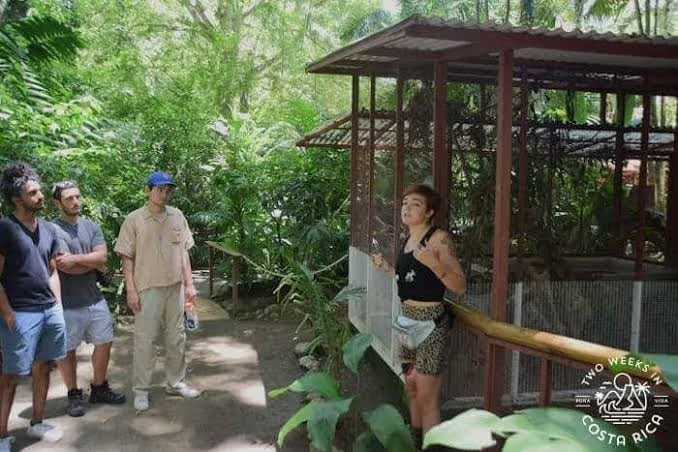
Leaving around 8:45 a.m., you drive about 20 kilometers from Cahuita to a private rescue center set in the rainforest, for a visit at 9:30 a.m. Its team cares for injured, sick or orphaned wild animals and, when their condition allows, gradually prepares them to return to the wild. You learn about this daily work and may see mammals, reptiles, butterflies and birds, sloths and frogs among them, depending on the day. In the afternoon, a second conservation project presents its programs for protection, breeding, reintroduction and habitat preservation, followed by a guided walk in the surrounding forest. With a little luck, birds, monkeys, sloths, frogs and reptiles reveal themselves along the trail.
A guide shares information with visitors next to wildlife enclosures surrounded by tropical vegetation.
Day 4
Cahuita National Park: forest trails and Caribbean coves
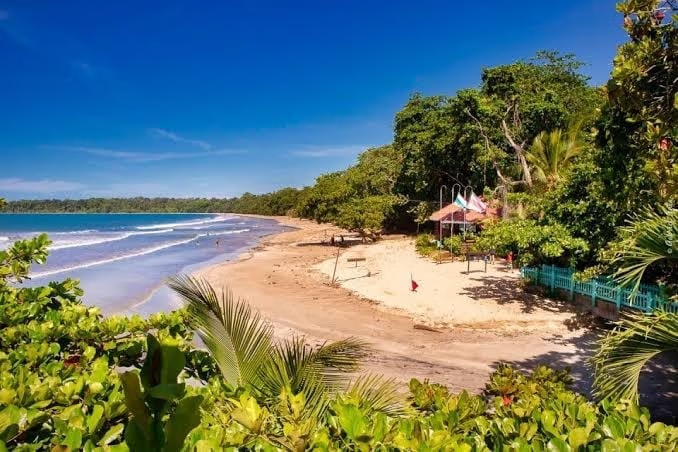
Today belongs to Cahuita National Park, protected for both its rainforest and its coral reefs. The park is open from 8:00 a.m. to 4:00 p.m., and the full trail between the Puerto Vargas and Cahuita entrances covers about 11 kilometers. You can walk it all, or enter from Cahuita, follow part of the path and turn back at your own pace. The trail threads between palms and lianas, often a few steps from the shore, with glimpses of turquoise sea. Watch for monkeys, iguanas, raccoons, coatis, sloths and basilisks, and stay alert for quieter reptiles. At Playa Blanca, you can swim, rest in the shade or enjoy a picnic to the sound of the waves. Park entrance is optional and paid on site.
Day 4 of the Costa Rica self-drive tour: the forest-fringed beach at the entrance of Cahuita National Park.
Day 5
Cahuita: an organic farm and a quiet river by kayak
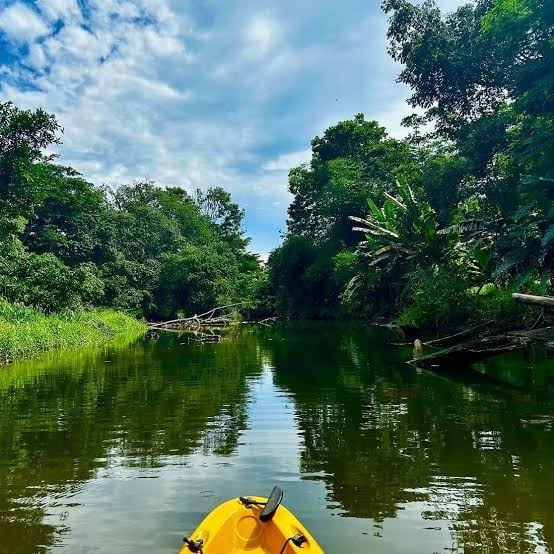
At 9:00 a.m., you meet your local guide for a day devoted to nature and genuine encounters. It begins at an organic farm, where you discover tropical crops and the practices of people who work their land with respect for the environment. You then settle into a kayak for a gentle paddle downriver between green banks. The river is a natural corridor: howler monkeys, toucans, iguanas and many birds may appear, while your guide helps you spot shyer animals and shares what he knows about the region and its plants. Lunch is included. Late in the afternoon, you return to your hotel for free time by the pool and a relaxed evening in the warm atmosphere of the Caribbean coast.
A yellow kayak glides along a calm, tree-lined river near Cahuita on day 5 of this Costa Rica self-drive tour.
Day 6
Sarapiquí: palm hearts, pineapples and red-eyed tree frogs
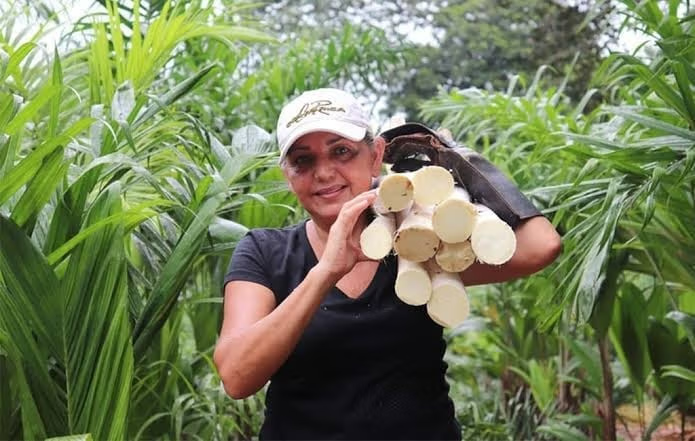
Around 8:30 a.m., you drive to Horquetas de Sarapiquí, a rural area known for family farming. At about 11:30 a.m., the owner of a small family farm shows you how palmito, heart of palm, is grown, and how mature palms produce pejibaye, a fruit cherished in Costa Rican cooking. After tasting fresh palm heart, lunch at the family soda features dishes such as palmito ceviche, lasagna, bread, chorreada or picadillo, depending on the day. Next, an organic pineapple and sugarcane farm walks you through each stage of cultivation, and you plant a young pineapple yourself before a tasting. From 6:00 p.m., a guided evening walk goes in search of the red-eyed tree frog and other creatures of the night.
A local farmer shows freshly cut sugarcane during a farm visit in Sarapiquí, a stop on this Costa Rica self-drive tour.
Day 7
Rafting the Río Sarapiquí, then on to Boca Tapada
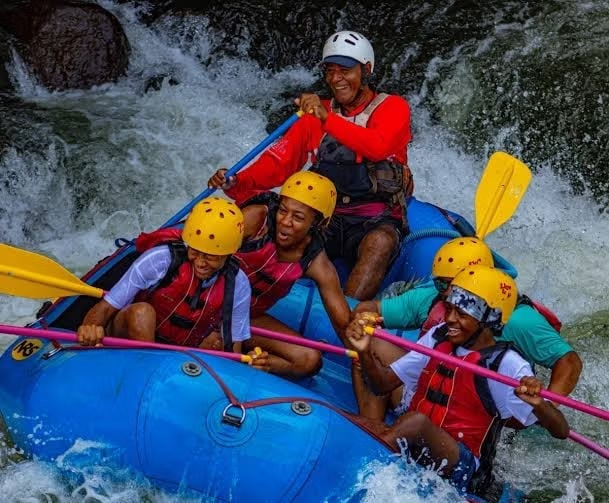
After breakfast, you head to an adventure center on the Río Sarapiquí, arriving no later than 9:15 a.m. A half-day rafting descent on class II and III rapids follows, led by a professional guide who gives a safety briefing first; calmer stretches leave time to admire the forested banks. If you prefer a gentler morning, you can choose instead a Safari Float of about two and a half hours, on a non-motorized raft or a motorboat, well suited to spotting birds, monkeys and reptiles. A traditional Costa Rican lunch awaits back at the center. You then discover the world of leaf-cutter ants and their surprisingly complex organization, before driving on to Boca Tapada, a wild and preserved corner of northern Costa Rica.
A family group paddles through foaming rapids with their guide during a rafting outing in the Sarapiquí area.
Day 8
Boca Tapada: by boat to the Río San Juan
Right from your lodging, you board a boat to the mouth of the Río San Carlos, where it meets the Río San Juan, here the natural border between Costa Rica and Nicaragua. The navigation is unhurried, through largely untouched rainforest. Herons, ibises, egrets and kingfishers line the banks, and with luck you may see caimans, iguanas, turtles and frogs, while snakes sometimes hide in the vegetation. Your guide helps you identify each species. Later, a guided rainforest hike in a reserve reveals the layers of the forest and its primates: howler monkeys, spider monkeys and capuchins may move through the canopy, along with birds, insects and reptiles, discreet but ever present.
A covered blue boat waits at the riverbank, ready for an excursion on day 8 of this Costa Rica self-drive tour.
Day 9
Arenal: a 70-meter waterfall and volcanic hot springs
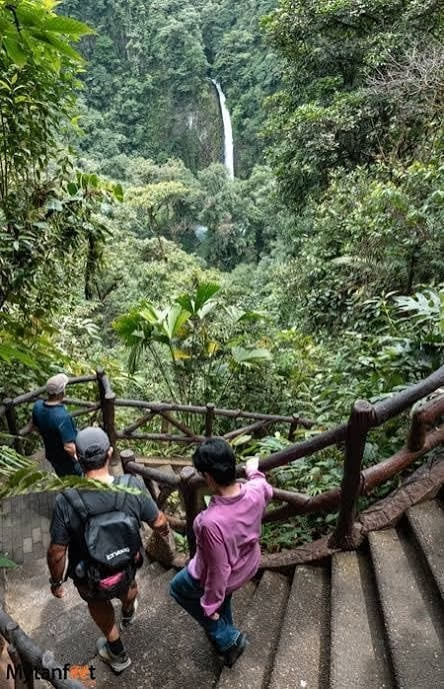
You drive through the green landscapes of San Carlos toward La Fortuna, as the near-perfect cone of Arenal Volcano, about 1,600 meters high, rises on the horizon. Its sudden eruption on July 29, 1968, opened a long period of activity; today it is calmer and closely monitored. Near La Fortuna, a staircase of about 530 steps, roughly 15 to 20 minutes down, leads to a waterfall more than 70 meters high, pouring into a natural pool. When conditions allow, you can swim, take photos and watch butterflies, birds and perhaps monkeys. The afternoon is spent at a hot springs complex fed by the volcano's geothermal waters, with pools of different temperatures, followed by an included buffet dinner at 7:00 p.m.
Hikers head down a stone staircase through dense rainforest, with a tall waterfall visible in the distance.
Day 10
Arenal Volcano National Park and the hanging bridges
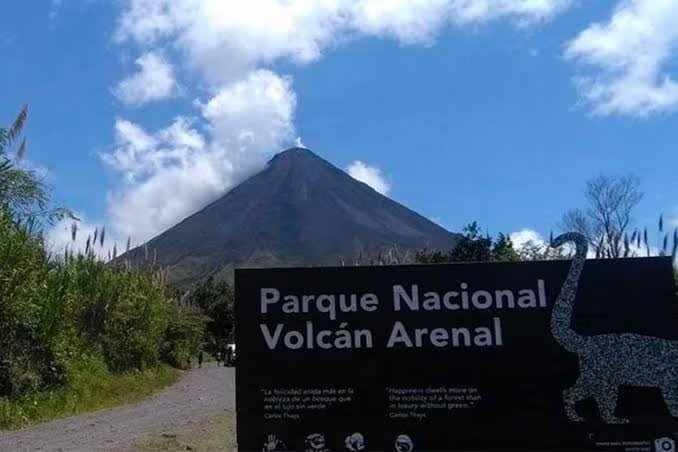
Around 8:30 a.m., you set out on a walk of 1.5 to 2 hours in Arenal Volcano National Park. Most of the trail is easy and nearly flat, through rainforest that has slowly reclaimed the land; a 200 to 300 meter stretch over old lava rock asks for more care and rewards you with views of the volcano and its lava fields when the sky is clear. Along the way you see the 1992 lava flows and a ceiba tree more than 400 years old. Park entrance is optional and paid on site. In the afternoon, a two-hour walk covers nearly 3 kilometers of trails with 8 fixed and 6 hanging bridges, some 48 to 98 meters long, for a rare look at the canopy.
The cone of Arenal Volcano towers over the entrance sign of Arenal Volcano National Park, a stop on a Costa Rica self-drive tour.
Day 11
Río Celeste: a turquoise river in Tenorio Volcano National Park
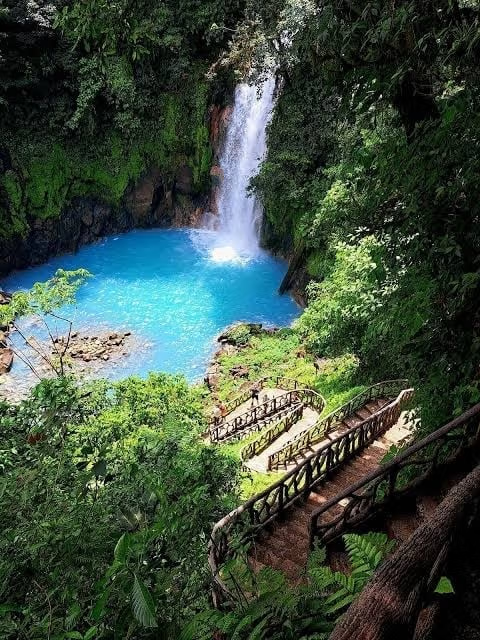
Departure around 7:30 a.m. for Tenorio Volcano National Park, in the Guanacaste volcanic range, arriving between 10:00 and 10:30 a.m. A hike of about three hours leads through dense forest of ferns, lianas and tall trees, home to birds and amphibians. The sound of water guides you to the Río Celeste waterfall, reached by 253 steps down and back up, where the river falls into a turquoise pool. The color is no trick: mineral particles in the water change the way light is scattered, an effect most visible at El Teñidero, where the river takes on its blue hue. After dark, a guided night walk by flashlight reveals frogs, insects, reptiles and spiders, and your guide explains their role in the ecosystem.
The Río Celeste waterfall drops into a bright turquoise pool, reached by a long wooden staircase through the rainforest.
Day 12
Cañas and the Río Corobicí, then Playa Sámara
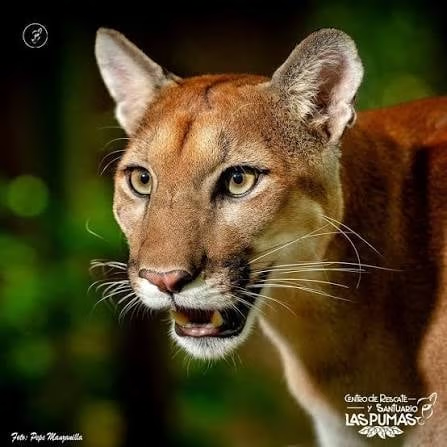
Around 7:30 a.m., you drive across the plains and pastures of northwestern Costa Rica to Cañas, in Guanacaste. Here a refuge first built through the work of Lilly and Werner Hagnauer cares for wild animals that can no longer return to their natural habitat, including native cats such as the puma, jaguar and ocelot, as well as several monkey species. Since 2003, a foundation has kept it running through visits, donations and sponsors. At 11:30 a.m., you board a boat for about an hour and a half on the Río Corobicí, watching American crocodiles and many birds along the banks of Guanacaste's dry tropical forest. After the included lunch, you continue to Playa Sámara.
A puma looks on attentively at a wildlife rescue center near Cañas, in Guanacaste.
Day 13
Playa Sámara: dolphins at sea, an afternoon on the beach
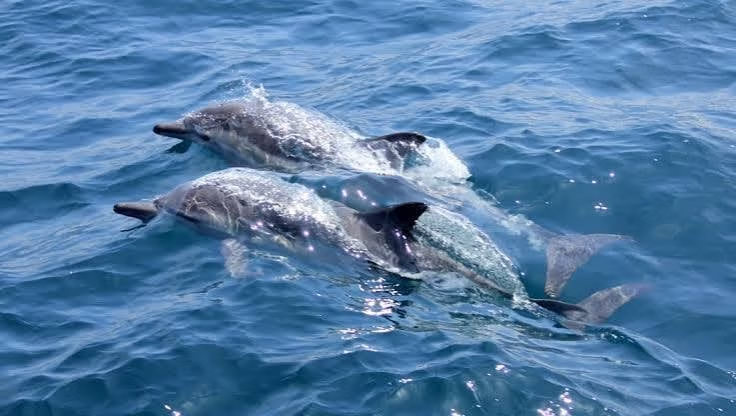
Around 8:00 a.m., the boat operator picks you up at your hotel reception for a shared outing off Playa Sámara. You look for dolphins and, depending on the season, the weather and the animals' presence, humpback whales, always with respectful viewing, against the backdrop of the Guanacaste coast. Back around noon, the afternoon is yours: stroll the shore, swim in the Pacific or simply settle into the slower rhythm of Sámara. As an option, a 6:30 p.m. departure to a nearby refuge dedicated to sea turtles offers the chance to observe nesting, mainly from July to January and sometimes into early February, under strict protection guidelines. It is booked with the same company as the morning boat trip.
Two dolphins break the surface together during a boat excursion from Playa Sámara.
Day 14
Paquera: paddling through bioluminescent water
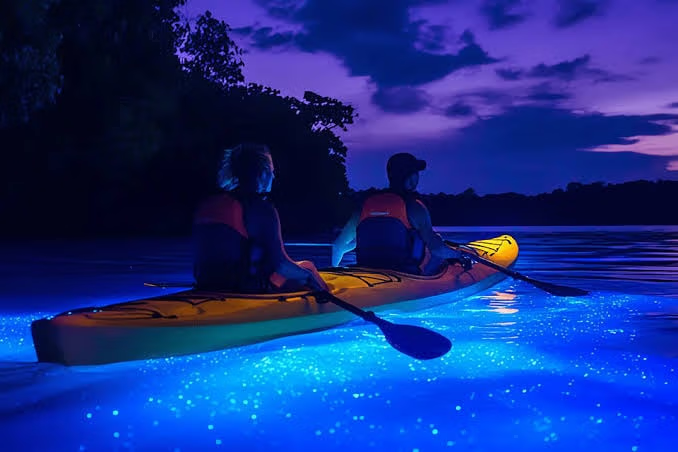
Today you head to Paquera, on the southern Nicoya Peninsula, for two nights. At nightfall, you slip into a kayak on calm coastal waters and paddle slowly away from the lights of the shore. With every stroke, the water lights up with tiny sparks: microscopic marine organisms produce bioluminescence, leaving delicate trails of light around your kayak, like a starry sky turned upside down. In the silence of the night, with the sounds of the tropical coast around you and often a sky full of stars overhead, this is a gentle, unusual way to connect with nature, far from the busier routes.
Paddling a tandem kayak through glowing bioluminescent water as night falls over the bay.
Day 15
Isla Tortuga and the islands of the Gulf of Nicoya
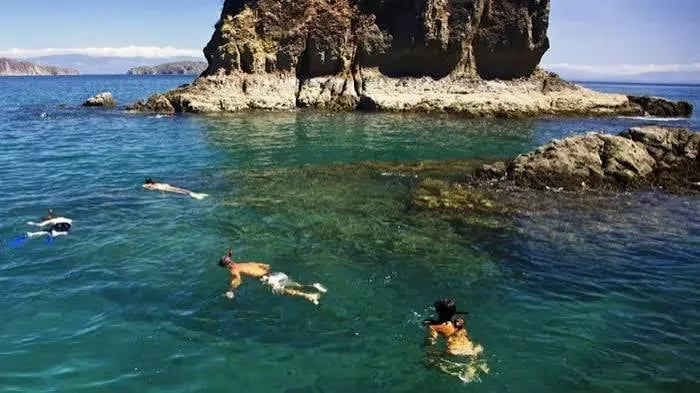
A full day at sea in the Gulf of Nicoya begins with a stop at Isla de los Monos, where spider monkeys live in their natural setting. The boat continues past the rock formations of Roca Corazón and Roca Arcoíris to clear water for a snorkeling session, with equipment provided and your guide alongside. Then comes Isla Tortuga, with pale sand beaches fringed by tropical vegetation, a place to swim, rest or simply enjoy island time. Lunch, fresh fruit and drinks are included, making this a relaxed, convivial day off the coast of the Nicoya Peninsula.
Snorkelers explore the clear turquoise waters around volcanic rock formations, an excursion option near Paquera on a Costa Rica self-drive tour.
Day 16
Ferry across the Gulf of Nicoya and back to San José
You board the ferry in Paquera with your car, bound for Puntarenas. Plan to reach the terminal at least 45 minutes before departure to secure a spot for your vehicle; schedules may change. During the crossing of about 1 hour 10 minutes, you can leave the car and step out on deck as the peninsula fades behind you, the gulf's islets and green shores unfold and, weather permitting, the mountains of the Pacific coast take shape. Seabirds are a common sight, and with luck dolphins may surface. The crossing also spares you a long road detour around the gulf. In Puntarenas, you drive off and continue to San José for your final night.
A car ferry carries vehicles and passengers across the water, a practical step on a Costa Rica self-drive tour.
Day 17
San José on foot, then the flight home
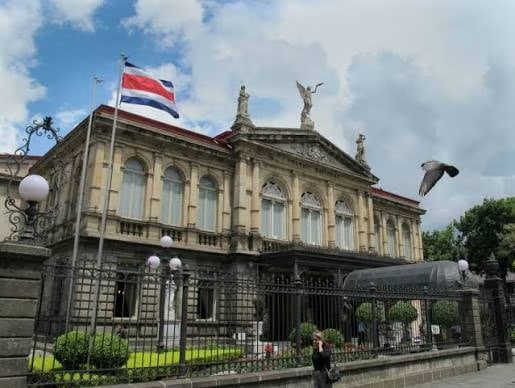
Your last morning is devoted to the capital. On a walking tour of the historic center, you explore the Central Market, with its stalls of tropical fruit, spices and crafts and the scent of Costa Rican coffee, then the Metropolitan Cathedral and the National Theater, inaugurated at the end of the 19th century. Time permitting, you may visit the Pre-Columbian Gold Museum or the Jade Museum; entrance fees to monuments and museums are not included. You then return your car to the rental office near the airport, from where you are taken to the terminal, with departure timed so that you arrive at least three hours before your flight. ¡Pura vida, and see you again in Costa Rica!
The neoclassical National Theater in downtown San José, a final stop before heading to SJO airport on a Costa Rica self-drive tour.
Where you will stay
San José · 1 night
A comfortable city hotel in San José with an executive king room, a calm first stop to rest after your flight.
Cahuita · 4 nights
A hotel on the southern Caribbean coast near Cahuita, with superior rooms and a pool, a relaxed base for exploring the national park and the coast toward Punta Cocles and Manzanillo.
Sarapiquí · 1 night
Family-style cabins in the green countryside of Sarapiquí, close to the farms and the forest of the evening frog walk.
Boca Tapada · 2 nights
Bungalows in a remote lodge by the river in Boca Tapada, surrounded by rainforest, with boat outings leaving directly from the property.
Volcán Arenal · 2 nights
A junior suite in a hotel near Arenal Volcano, convenient for the national park, the hanging bridges and the area around La Fortuna.
Volcán Tenorio (Río Celeste) · 1 night
Bungalows set in nature near Tenorio Volcano National Park, ideal after the Río Celeste hike and the night walk.
Playa Sámara · 2 nights
A double bungalow near the beach at Playa Sámara, on the Pacific coast of Guanacaste.
Paquera · 2 nights
A deluxe room in a hotel on the southern Nicoya Peninsula, near Paquera, well placed for the island excursion and the ferry.
San José · 1 night
A comfortable city hotel in San José with an executive king room, handy for the walking tour and the return to the airport.
What the package includes
Included
Private transfer from the airport to the rental agency
Nights in the hotels listed, or similar if unavailable before final booking
Breakfast every day of the tour
Lunches mentioned in the program *
Dinners mentioned in the program *
Mandatory PLI / LWD insurance
Car rental with the mandatory insurance
National park entrance fees listed as included in the program
Activities and visits listed as included in the program
Private transfer to the airport on departure day
The 13% hotel tax
The 13% tax on tourist activities
Our assistance in English throughout your stay
* Meals include a main course and one non-alcoholic drink
National park entrance fees listed as optional in the program
Activities and visits listed as optional in the program
Extensions, variations and suggestions
Personal expenses and tips
Travel or repatriation insurance
Not included: road costs, fuel, parking, ferries and tolls
Any other service
Optional activities
Cahuita National Park entrance fee: USD 6, payable on site
Arenal Volcano National Park entrance fee: USD 17, payable on site
Night sea turtle watching tour: USD 45, payable on site
Who this trip is for
This self-drive trip in Costa Rica suits travelers who are comfortable behind the wheel and enjoy setting their own pace while knowing that lodging and activities are already arranged. Couples, friends and families will all find their place, with room options for two to four travelers: a double, a triple, a quadruple or two doubles. Nature lovers, birdwatchers and photographers will appreciate the variety of ecosystems, from Caribbean rainforest to Guanacaste's dry forest, while curious minds will enjoy the farm visits and rescue centers. A reasonable level of fitness helps: some days include stairs of several hundred steps, a three-hour hike or uneven lava rock, but trails can often be shortened, and the rafting morning has a calmer river alternative.
Frequently asked questions
What is included in this Costa Rica self-drive tour?
The package includes the private transfer from the airport to the rental agency on arrival, the rental car with mandatory insurance, 16 nights in the hotels listed or similar, daily breakfast, the lunches and dinner mentioned in the program (main course and a soft drink), the national park entrances and activities marked as included, the transfer to the airport on departure day, the 13% hotel and tourism taxes, and the agency's assistance throughout your stay.
What is not included in the price?
International flights, drinks outside meals and alcoholic drinks, the optional entrances to Cahuita and Arenal Volcano National Parks, the optional turtle nesting tour, fuel, parking and tolls, personal expenses and tips, travel or repatriation insurance, and the deductible buy-back insurance (SPP), which is strongly recommended. Entrance fees to museums and monuments in San José are also extra.
When can I see sea turtles nesting near Playa Sámara?
The optional evening outing to a turtle refuge runs mainly from July to January, with sightings sometimes continuing into early February. Nesting always depends on natural conditions and the presence of the turtles, and the outing is booked with the same company that runs the dolphin boat trip.
How physically demanding is this 17-day Costa Rica itinerary?
Most activities are accessible to travelers in reasonable shape. The waterfall near La Fortuna requires about 530 steps down and back up, the Río Celeste hike lasts around three hours with 253 steps, and the Arenal lava trail includes a 200 to 300 meter stretch over uneven rock. In Cahuita National Park, you can walk only part of the 11-kilometer trail.
Do I have to go rafting on the Río Sarapiquí?
No. The rafting descent runs on class II and III rapids, but you can replace it with a Safari Float of about two and a half hours on a non-motorized raft or a motorboat, a calmer way to enjoy the river and watch for wildlife.
From the coffee mills of Turrialba to the glowing water off the Nicoya Peninsula, this Costa Rica self-drive tour lets you discover the country at a pace that leaves room for curiosity, encounters and rest. If this route matches the journey you have in mind, simply share your travel dates and the number of travelers with the Vacances au Costa Rica team, and we will be glad to prepare a detailed quote for you.
Request this tour
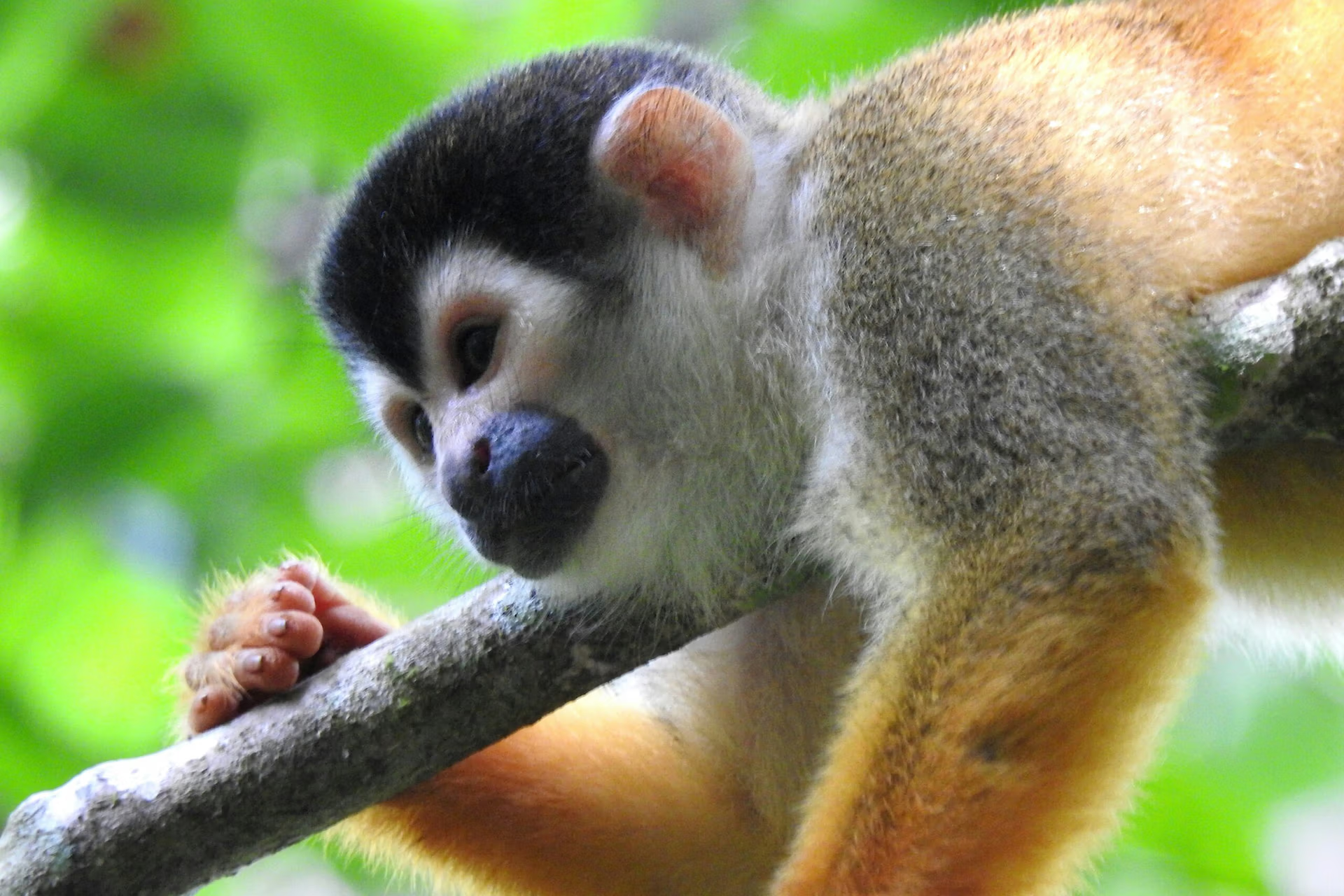
Tell us your dates and who is traveling: we will reply with a personalized quote for “Squirrel Monkey Tour”.
Manage consent
We use cookies to measure site traffic, display certain content (videos, maps, reviews) and improve your visit. You can accept them, refuse them or choose which ones you allow; you can change your choice at any time.
Functional
Always active
The technical storage or access is strictly necessary for the legitimate purpose of enabling the use of a specific service explicitly requested by the subscriber or user, or for the sole purpose of carrying out the transmission of a communication over an electronic communications network.
Preferences
The technical storage or access is necessary for the legitimate purpose of storing preferences that are not requested by the subscriber or user.
Statistics
The technical storage or access that is used exclusively for statistical purposes.The technical storage or access that is used exclusively for anonymous statistical purposes. Without a subpoena, voluntary compliance on the part of your Internet Service Provider, or additional records from a third party, information stored or retrieved for this purpose alone cannot usually be used to identify you.
Marketing
The technical storage or access is required to create user profiles to send advertising, or to track the user on a website or across several websites for similar marketing purposes.