At dawn, the call of oropendolas rings out above the banana trees, a hummingbird hovers in front of a flower, a pair of scarlet macaws crosses the valley calling. With more than 900 species recorded on a small territory, Costa Rica is one of the great birdwatching destinations. There is no need to be an ornithologist to enjoy it: a good guide and a few mornings are enough.
Costa Rica lies at the crossroads of North and South American fauna. Its relief creates a great variety of habitats in little space: lowland forests on both coasts, cloud forests, the dry forest of Guanacaste, mangroves, wetlands, high-altitude grasslands. Many North American migratory birds also spend the winter here, from October to April. Finally, the network of parks and reserves protects a large part of these habitats.
Iridescent green plumage, red belly, long tail feathers in the male: the quetzal was sacred to the Maya and Aztec peoples. It lives in the mountain forests of Monteverde, San Gerardo de Dota and Los Quetzales National Park. The best period runs from February to May, during nesting. A local guide who knows the trees where it feeds is almost essential.
The scarlet macaw is seen mainly on the Osa Peninsula and in Carara National Park. The rarer great green macaw lives in the Northern Plains and on the Caribbean slope, especially around Boca Tapada and Sarapiquí.
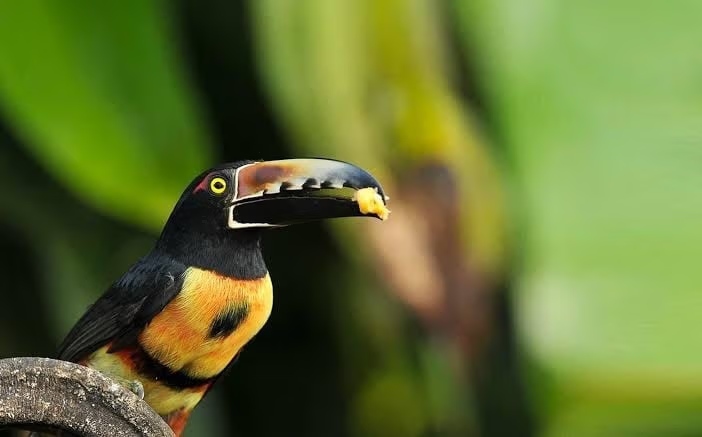
The keel-billed toucan, with its multicolored bill, and the yellow-throated toucan frequent lowland forests; the smaller aracaris move in groups. They are often seen in lodge gardens in La Fortuna, Sarapiquí or Tortuguero.
The country has about fifty hummingbird species, some of them tiny. The flowering gardens and feeders of Monteverde or San Gerardo de Dota let you watch them at very close range.
Some species live only in Costa Rica or western Panama, such as the coppery-headed emerald, a small mountain hummingbird. Specialist guides help enthusiasts complete their lists.
In the Savegre River valley, above 2,000 meters, the quetzal is seen regularly, along with many mountain forest species. Bring warm clothes: mornings are cool.
The Monteverde, Santa Elena and Curi-Cancha reserves offer a great diversity of cloud forest species. Guides are numerous and experienced. See our Monteverde guide.
The lowland forests of the north, around La Selva Biological Station, Sarapiquí and Boca Tapada, are home to toucans, aracaris, trogons, manakins and the great green macaw.
Between the dry forest of the north and the humid forest of the south, Carara National Park is a good site for the scarlet macaw. The banks and mouth of the Tárcoles River attract herons, spoonbills and other waterbirds.
A dawn boat trip on the canals reveals kingfishers, herons, anhingas, toucans and sometimes the great green macaw.
Birds are most active at dawn and in the two hours that follow, then in the late afternoon. The hot hours are quieter. A night outing lets you look for potoos and owls.
A birding guide, with a spotting scope, turns a walk into a real discovery. We organize these outings in each region of your itinerary.
All year. From October to April, North American migrants join the local species; from February to May, it is quetzal season.
No. Many of our travelers discover birdwatching on site, simply by following a guide for a morning.
Yes: most stops lend themselves to it. Our tours passing through San Gerardo de Dota, Monteverde or Boca Tapada are presented below.


Learn more
Let’s talk about your trip
Your dates, your wishes, the pace that suits you: a travel consultant based in Costa Rica will suggest a tailor-made itinerary within 48 business hours.


