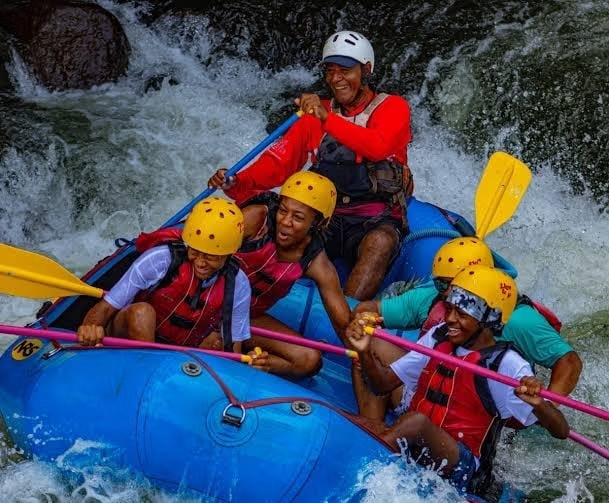
The raft glides between two fern-covered walls, a waterfall drops straight into the river, then the guide calls out the next rapid. With its relief, abundant rain and rivers flowing from the mountain ranges toward two oceans, Costa Rica offers rafting for every level, from family floats to the most demanding rapids.
On the Caribbean slope, near Turrialba, the Pacuare runs through gorges covered with rainforest, with class III and IV rapids. It is often cited among the most beautiful rafting rivers in the world. It can be run in a day, or over two days with a night in a riverside lodge reachable only by the river.
Also near Turrialba, the Reventazón offers several sections of varying difficulty. The construction of a dam changed the flow of some of them: operators indicate the open sections depending on the season.
Around La Fortuna, the Balsa and Toro rivers are run in half a day: the first suits beginners and families, the second, more enclosed, thrill-seekers. See our La Fortuna guide.
In the Northern Plains, the Sarapiquí offers class II and III sections, suitable for beginners and families. Its banks are rich in birds; the run is easily combined with a visit to La Selva Biological Station.
About an hour from Manuel Antonio, the Savegre descends a lush valley with class II to IV sections depending on the water level. See our Manuel Antonio guide.
| Class | Rapids | For whom |
|---|---|---|
| I and II | Calm to easy | Beginners, families |
| III | Moderate, some maneuvering | Active beginners, families with teenagers |
| IV | Powerful and technical | People in good shape, prior experience recommended |
| V | Very difficult | Experienced rafters |
Without experience, choose classes II and III (Sarapiquí, Balsa). In good physical condition, classes III and IV (Pacuare, Savegre) are accessible with an experienced guide.
This is the most memorable rafting experience in the country: a first day of rapids with breaks for swimming, a night in a lodge deep in the forest, to the sound of the river and the frogs, then a second day running down toward the Caribbean plains. A fine way to link the Central Valley with the Caribbean coast.
Rafting is possible all year. From May to November, rivers are higher and rapids more powerful; some trips may be canceled after very heavy rain. From December to April, more moderate flows better suit beginners and families. See our guide When to go.
Trips are run by professional operators who provide a life jacket, helmet and paddle, and give safety instructions before departure. You must be able to swim. The minimum age depends on the river and the operator: often around 8 to 10 for classes II and III, older for class IV. Bring shoes that stay on your feet, a swimsuit, sunscreen and a change of clothes.
From La Fortuna, Sarapiquí, Turrialba or Manuel Antonio, tours generally pick you up at your hotel. We book them with reliable operators and include them in your itinerary.
Not for classes II and III. For class IV, prior experience and good physical condition are recommended.
Yes, on the Sarapiquí or the Balsa, depending on the children’s ages. See our family guide.
Led by professionals, on a river suited to your level, the risk is low. Always follow the guide’s instructions.


Learn more
Let’s talk about your trip
Your dates, your wishes, the pace that suits you: a travel consultant based in Costa Rica will suggest a tailor-made itinerary within 48 business hours.