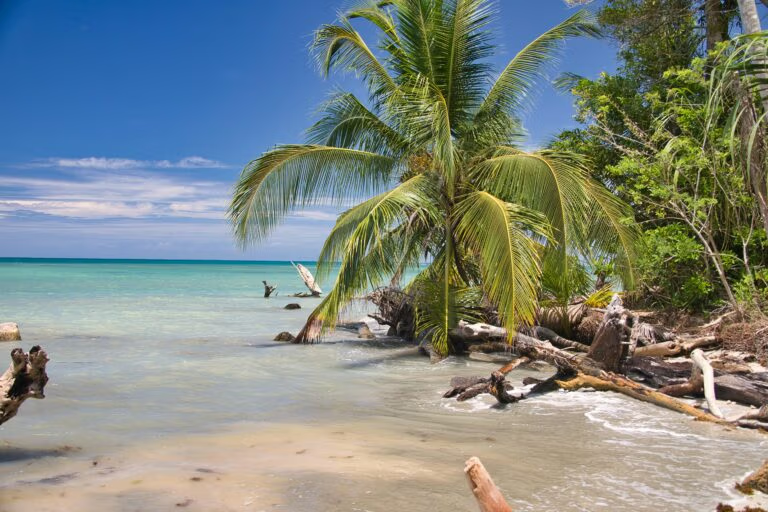
On the trail, a capuchin monkey crosses overhead, a sloth sleeps in the fork of a tree, then the forest opens onto a curved beach. Manuel Antonio, on the central Pacific coast, brings together rainforest, wildlife and the sea in a small area. It is one of our travelers’ favorite stops.
Created in 1972, it is one of the smallest national parks in the country, but one of the richest to explore. It protects a tropical rainforest, several beaches and small islands offshore.
Good to know: the park is closed on Tuesdays. Visitor numbers are limited and tickets must be booked online in advance, especially from December to April and in July and August.
White-faced capuchins, howler monkeys, squirrel monkeys (found only on the southern Pacific coast of Costa Rica and in Panama), two- and three-toed sloths, raccoons, agoutis, iguanas and basilisks are often seen along the trails. Toucans, tanagers and woodpeckers liven up the canopy. A naturalist guide with a spotting scope finds animals you would never see on your own.
The park’s main beach is a crescent of pale sand, sheltered by a headland. When the sea is calm, it is one of the most pleasant beaches in the area for swimming. Monkeys sometimes come down to the sand: never feed them, and keep your bags closed.
Longer and more exposed, it has stronger waves: lovely for a walk, less so for swimming.
Outside the park, this small cove is reached by a short trail from the Manuel Antonio area. Its calm water is good for snorkeling when the sea is clear.
The large public beach at the park entrance, with restaurants and surf schools. The waves call for caution.
A few kilometers from the park, Quepos is the area’s small town: a market, seafood restaurants and a marina where boat trips leave from. The road between Quepos and the park winds up a hill, with fine views of the Pacific.
The trails are easy and link the entrance to the beaches and viewpoints. Arrive at opening time: wildlife is more active and the heat milder.
By catamaran or boat, you can watch dolphins, turtles and, from July to October and again from December to March, humpback whales, often with a snorkeling stop.
The Savegre River, about an hour away, offers sections of varying difficulty depending on the season.
The mangroves near Quepos can be explored by kayak, at high tide, with a guide.
From San José, allow about 3 hours on the Pacific coast highway. Shared shuttles link Manuel Antonio with the other stops; small planes also serve Quepos. On the way, the Tárcoles River bridge is a good place to see large crocodiles (see our Tárcoles River crocodile tour), and Carara National Park is home to scarlet macaws.
Lodging is spread over the hill between Quepos and the park: boutique hotels with ocean views, lodges in the forest, villas for families. We choose them according to the calm, the view and the distance to the park that suit you.
Two nights allow for the park visit and some beach time; three nights leave room for a boat trip or rafting. Keep Tuesday, when the park is closed, in mind when planning your days. Manuel Antonio combines naturally with Arenal, Monteverde and the southern Pacific, as in the tours below.
It is not mandatory, but strongly recommended: you will see many more animals.
Yes, on the designated beaches, when the sea is calm. Follow the posted instructions.
All year round. From December to April, the weather is drier; from May to November, the forest is greener and showers fall mostly in the afternoon. See our guide to the best time to visit Costa Rica.
Yes: easy trails, wildlife you can actually see and sheltered beaches.


Learn more
Let’s talk about your trip
Your dates, your wishes, the pace that suits you: a travel consultant based in Costa Rica will suggest a tailor-made itinerary within 48 business hours.