
Contents
- A coast apart, shaped by its history
- Cahuita: a quiet village and its national park
- The Cahuita reef, just below the surface
- Puerto Viejo de Talamanca: beaches, bikes and village life
- Manzanillo and the Gandoca-Manzanillo refuge
- Meeting the Bribri of Yorkín
- When to go and how to get there
- Cahuita or Puerto Viejo: where to stay?
- Conclusion
- Frequently asked questions
- Sources
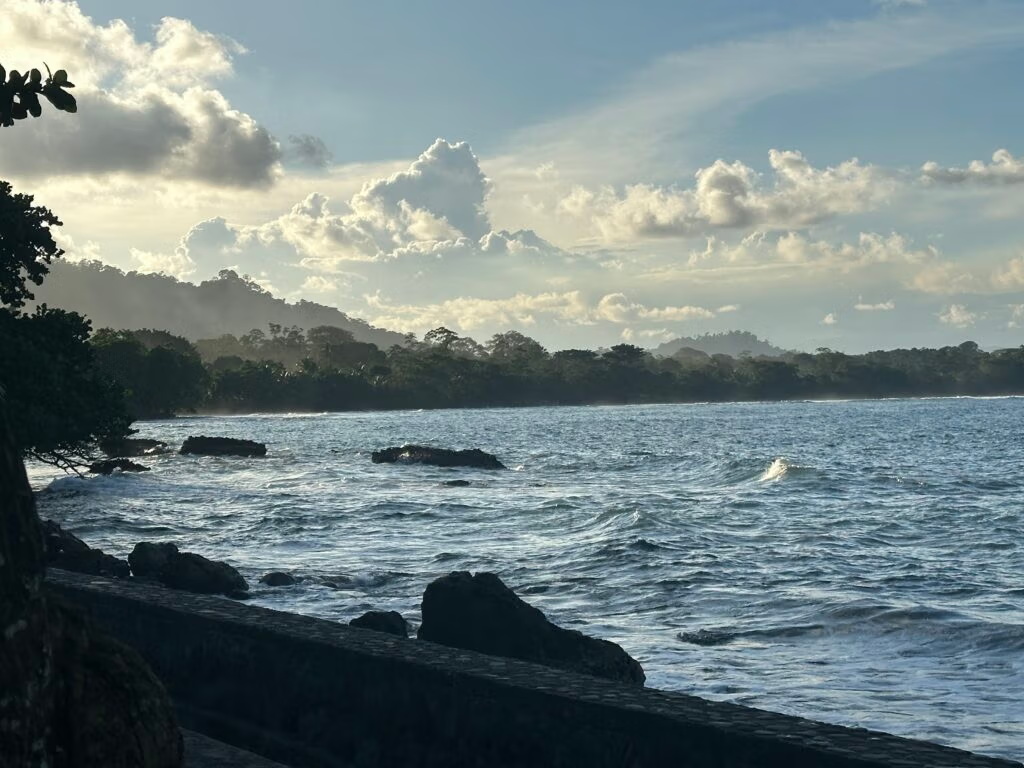
Past the cloud forest of Braulio Carrillo National Park, the road descends toward the Caribbean Sea and the air changes: warmer, heavier, scented with coconut and wet earth. South of the port of Limón, a small road follows the coast to the Panama border. Cahuita, Puerto Viejo de Talamanca and Manzanillo follow one another, between palm-lined beaches, coastal forest and coral reefs. Spanish is spoken here, but also an English-based creole, and rice is cooked in coconut milk. Here is what we know of this coast, to help you decide whether it belongs in your itinerary, and how to experience it.
A coast apart, shaped by its history
The Caribbean coast does not look like the rest of the country, and its history explains why. From 1872, workers mostly from Jamaica arrived in Limón to build the railroad that was to link the Central Valley to the port. Many thought they would leave; most stayed, then worked on the banana plantations. Their descendants have kept a language, a cuisine, a music and churches of their own. Until 1949, most Afro-Costa Ricans lived in the province of Limón and had no access to Costa Rican citizenship: this history, long kept aside, is now part of the country’s identity.
Further south and in the foothills of the Talamanca range live the Bribri, one of Costa Rica’s Indigenous peoples. Their territory, crossed by rivers, stretches to the Panamanian border. The southern Caribbean coast can thus be understood as a meeting place: Afro-Caribbean heritage on the shore, Bribri culture inland, and travelers from all over the world in the villages.
Cahuita: a quiet village and its national park
Cahuita is a village of a few streets, wooden houses and restaurants open to the street. Life moves slowly, and many travelers choose it precisely for that. Its main attraction begins at the end of the village: Cahuita National Park, created in 1970 as a national monument and made a national park in 1978, to protect the country’s largest coral reef.
The park has two entrances. The Kelly Creek entrance, at the edge of the village, works on a voluntary donation basis; the Puerto Vargas entrance, further south, charges a fee. Between the two, a trail of about 8 km follows the coast under the trees, with the sea on one side and the forest on the other. It is not a loop: you retrace your steps, or arrange transport from the other entrance. The ground is flat, sometimes sandy or muddy, and suits most walkers.
Along the trail, howler monkeys are heard long before they are seen. Sloths, raccoons, iguanas and land crabs are often spotted, and a local guide helps you see what you would not notice alone: a snake motionless on a branch, a frog under a leaf. Opening hours may vary by sector; we advise you to check them before your visit.
The Cahuita reef, just below the surface
What makes Cahuita special lies largely beneath the surface. The reef shelters corals, sponges and tropical fish that you can observe simply with a mask and snorkel. In the park, snorkeling is done with a guide, who chooses the site according to sea conditions and visibility. After heavy rain or in rough seas, the water clouds and the outing may be postponed: one of the reasons to keep some flexibility in your stay.
If you would like to arrange this outing, our Cahuita snorkeling tour is led by a local guide, from the village, in the morning or late morning.
Puerto Viejo de Talamanca: beaches, bikes and village life
A quarter of an hour’s drive south, Puerto Viejo is livelier. The village lives to the rhythm of surfers, small cafés, chocolate workshops and evenings that stretch on. Just offshore, the Salsa Brava wave rises over a reef: it is reserved for experienced surfers, and people mostly come to watch it from the beach.
The best way to explore the surroundings is often by bike. A coastal road links Puerto Viejo to Manzanillo via the beaches of Cocles, Playa Chiquita and Punta Uva, where the forest comes down to the sand. You stop for a swim, set off again, pause for a fresh fruit juice. Stay alert to traffic, especially in the evening, and use a light on your bike if you return late.
Nearby, two visits help you better understand the region’s wildlife. At Punta Cocles, a wildlife rescue center cares for injured or orphaned animals before preparing them, when possible, to return to the forest. In Manzanillo, the Ara Project works on breeding and reintroducing the great green macaw.
Manzanillo and the Gandoca-Manzanillo refuge
The road ends in Manzanillo, a small fishing village. Beyond it begins the Gandoca-Manzanillo National Wildlife Refuge, which protects coastal forest, swamps, mangroves, beaches and reefs up to the Panama border. Entry is free. From the village, a coastal trail of about 5 km leads to Punta Mona, past coves and headlands from which dolphins are sometimes seen.
Gandoca beach is also one of the leatherback turtle’s nesting sites on the Caribbean coast, roughly from March to July. Community patrols watch over it at night. If you wish to see a turtle nesting, do so only with a certified guide, without a flashlight or flash photography: the turtles’ peace comes first.
Meeting the Bribri of Yorkín
Inland, the Yorkín River marks part of the border between Costa Rica and Panama. The Bribri community living on its banks welcomes visitors, provided its rhythm is respected. You arrive by dugout canoe from Bambú, traveling up the Telire and Yorkín rivers. On site, the women of the community present their traditional architecture, cacao processing, crafts and meals shared under the rancho.
This encounter is best lived without haste. Our two-day tour with the Bribri of Yorkín lets you spend a night there, share village life and travel back down the river the next morning.
When to go and how to get there
The Caribbean coast follows a different rhythm from the Pacific side. Humidity is present all year and a shower can fall in any season. September and October, the wettest months on the Pacific, are often among the sunniest here, and the sea is generally calmer and clearer. February and March are also fairly dry. To compare regions month by month, see our guide when to go to Costa Rica.
From San José, allow generally 4 to 5 hours’ drive to Puerto Viejo, on Route 32 through Braulio Carrillo National Park, then on the coastal road south of Limón. Route 32 is sometimes temporarily closed by landslides after heavy rain, in which case a longer detour is needed. Fog is also frequent in the mountains. You can drive yourself, take a shuttle or a private transfer. The southern Caribbean coast combines well with Tortuguero, further north and reached by boat, or with the Sarapiquí region and Arenal Volcano.
Cahuita or Puerto Viejo: where to stay?
This is one of the questions we are asked most often. The two villages are close, and you can stay in one while enjoying the other. Cahuita suits those looking for calm, walking access to the national park and peaceful evenings. Puerto Viejo is livelier, with more restaurants and a more festive atmosphere. Between Cocles and Punta Uva, many lodgings sit in the heart of the forest, a little apart: a bike, a vehicle or a driver is then more practical.
As for length, three nights let you discover Cahuita park, a sea outing and a day by bike to Manzanillo. With four or five nights, you can add the night with the Bribri, a wildlife visit or simply time to do nothing, which is also part of the spirit of this coast.
Conclusion
The southern Caribbean coast is not approached as a mere beach stop. People come for a reef to observe just below the surface, trails where howler monkeys are heard before they are seen, coconut-milk cooking and a history that sheds light on another side of Costa Rica. It asks for some time and flexibility with the weather, and that is often what makes it so appealing. If you would like to include it in a tailor-made itinerary, at your pace and with our local French-speaking team, let’s talk about your project.
Frequently asked questions
Do you have to pay to enter Cahuita National Park?
At the Kelly Creek entrance, in the village of Cahuita, access is by voluntary donation. At the Puerto Vargas entrance, a fee is charged. Conditions may change: check them before your visit.
How many days should I plan on the southern Caribbean coast?
Three nights are a minimum to discover Cahuita, Puerto Viejo and Manzanillo without rushing. Four or five nights let you add a snorkeling trip, a wildlife visit or a night in the Bribri community of Yorkín.
What is the best time for the Caribbean coast?
September and October are often the sunniest months, with a calmer, clearer sea; February and March are also fairly dry. Showers remain possible all year.
Can you swim in Cahuita and Puerto Viejo?
Yes, on many beaches, but currents can be strong in places. Ask locally, preferably swim where residents swim and avoid rough seas.
Do you need a car to visit the region?
Not necessarily. A shuttle or private transfer gets you to the coast from San José, then bikes and taxis are enough to move between Cahuita, Puerto Viejo and Manzanillo. A car gives more freedom if your lodging is isolated.
Sources
- Visit Costa Rica (ICT and SINAC), Cahuita National Park fact sheet: visitcostarica.com
- Visit Costa Rica (ICT and SINAC), Gandoca-Manzanillo refuge fact sheet: visitcostarica.com
- Wikipedia, Cahuita National Park (history): en.wikipedia.org
- Lonely Planet, Cahuita National Park (entrances): lonelyplanet.com
- Wikipedia, Afro-Costa Ricans (history of the Limón railroad): en.wikipedia.org
- Tico Times, history of the Limón railroad (2026): ticotimes.net
- WWF, the leatherback turtle in Gandoca-Manzanillo: wwf.panda.org
- Rough Guides, San José to Puerto Viejo: roughguides.com
- Two Weeks in Costa Rica, the Gandoca-Manzanillo refuge: twoweeksincostarica.com
Tours to inspire you


Learn more
Let’s talk about your trip
Your dates, your wishes, the pace that suits you: a travel consultant based in Costa Rica will suggest a tailor-made itinerary within 48 business hours.