
Contents
A quetzal motionless on a mossy branch, a sloth slowly turning its head, a green turtle climbing the beach of Tortuguero in the dark: in Costa Rica, wildlife is part of the trip, not only of the tours. The country is home to nearly 6% of the world’s biodiversity in an area about the size of West Virginia.
Since 2014, we have been preparing nature-focused trips. Here are the species our travelers most hope to see, and the places where their chances are best.
Biodiversity in a few figures
| Group | Number of species (approx.) | Good to know |
|---|---|---|
| Birds | more than 900 | Including migrants from North America |
| Mammals | about 250 | Including six species of wild cats |
| Reptiles | more than 200 | Including several sea turtles |
| Amphibians | about 200 | Including the small poison dart frogs |
| Orchids | more than 1,300 | Mostly in the cloud forests |
Ten species to look for
1. The resplendent quetzal
The male has long, iridescent green tail feathers. It lives in mountain forests: San Gerardo de Dota, Monteverde, around Cerro de la Muerte. The best period is from February to May, during nesting.
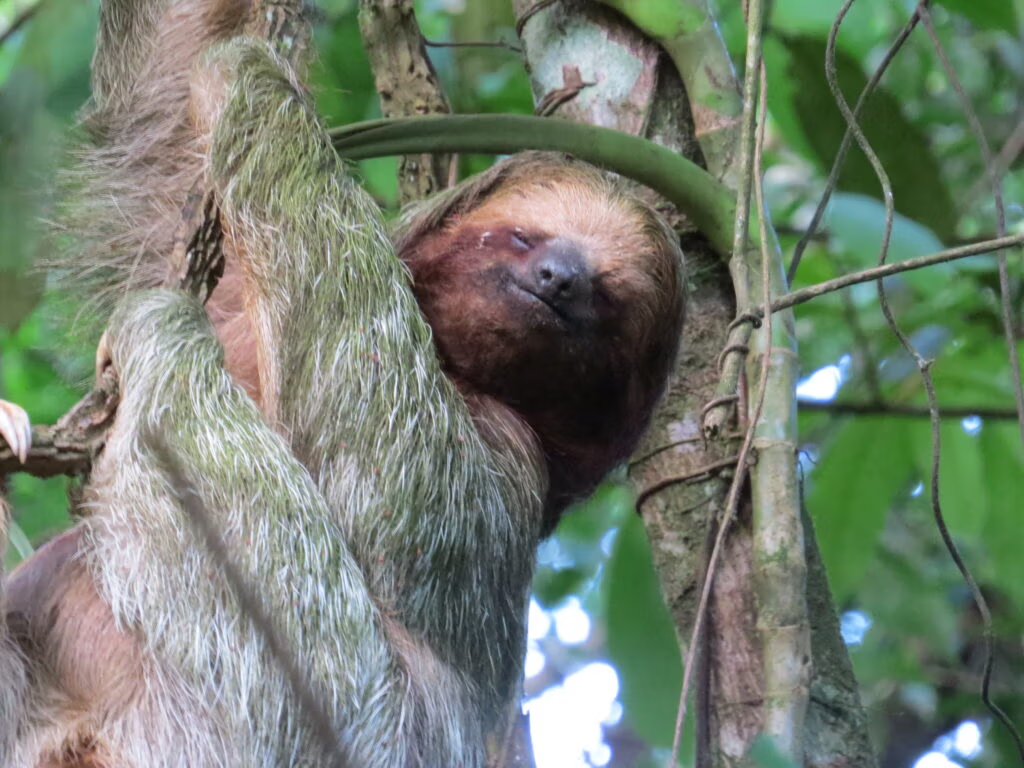
2. The sloth
Two-toed and three-toed sloths sleep most of the day, often high in the trees. They are often seen in Manuel Antonio, Cahuita, Sarapiquí or around Arenal, especially with a guide carrying a spotting scope.
3. The strawberry poison dart frog
Bright red with blue legs, this small frog advertises its toxicity. It is harmless as long as you do not touch it. It is mostly seen on the Caribbean slope and in Sarapiquí.
4. The keel-billed toucan
Its multicolored bill makes it unmistakable. It lives in lowland forests: Arenal, Sarapiquí, Tortuguero, the Caribbean coast.
5. The squirrel monkey
The Central American squirrel monkey lives only on the southern Pacific coast of Costa Rica and in Panama. Endangered, it is mostly seen in Manuel Antonio and on the Osa Peninsula, in small, lively troops.
6. The scarlet macaw
You hear its calls before you see its colors. Scarlet macaws live in pairs and small groups, especially on the Osa Peninsula and in Carara National Park.
7. Sea turtles
Several species nest on the country’s beaches:
| Species | Where | When |
|---|---|---|
| Green turtle | Tortuguero (Caribbean) | July to October |
| Leatherback turtle | Playa Grande (Guanacaste) | October to March |
| Olive ridley turtle | Ostional (Nicoya) | Mainly July to December |
Night watching is always done with a certified guide.
8. The humpback whale
Two populations take turns on the Pacific coast: those from the southern hemisphere from July to October, those from the northern hemisphere from December to March. Uvita and Drake Bay are the best starting points. See our whale watching guide.
9. Baird’s tapir
Central America’s largest land mammal is discreet. Corcovado National Park offers the best chance of meeting one, with a guide.
10. The American crocodile
Under the bridge over the Tárcoles River, on the road to the Pacific coast, large crocodiles rest on the sandbanks. A stop of a few minutes, from the pedestrian walkway. See our Tárcoles River crocodile tour.
The best places for wildlife
| Place | What to see | Access |
|---|---|---|
| Tortuguero | Green turtles, caimans, monkeys, canal birds | Boat or small plane |
| Manuel Antonio | Three monkey species, sloths, raccoons | Easy |
| Monteverde | Quetzal, hummingbirds, night wildlife | Easy |
| Corcovado (Osa) | Tapir, scarlet macaws, four monkey species | Guide mandatory |
| Sarapiquí | Frogs, toucans, howler monkeys | Easy |
| Carara and Tárcoles | Scarlet macaws, crocodiles | Easy |
Our guide to Costa Rica’s national parks presents these places in detail.
Our tips for better wildlife watching
- Set off early: between 6 and 9 a.m., animals are more active and the heat milder.
- Take a naturalist guide: they spot in seconds what you would search for alone for hours.
- Keep your distance, and never touch or feed animals.
- Bring binoculars.
- Plan a night walk: frogs, insects, snakes and small mammals come out after sunset.
Frequently asked questions
Can I see a jaguar?
Jaguars live in Costa Rica, especially on the Osa Peninsula, but they are very discreet. Sightings remain rare.
Are there dangerous animals?
Animals usually avoid people. Venomous snakes do exist: stay on the trails, wear closed shoes and watch where you put your hands. Do not swim in estuaries, where crocodiles live.
What is the best place for wildlife?
Manuel Antonio for ease, Corcovado for the wildest nature, Tortuguero from July to October for the turtles.
Is wildlife protected?
Yes. Hunting is strictly regulated, trade in wild animals is prohibited, and about a quarter of the country is protected.
Tours that pass through here
Learn more
Let’s talk about your trip
Your dates, your wishes, the pace that suits you: a travel consultant based in Costa Rica will suggest a tailor-made itinerary within 48 business hours.